

Home |
Taking a different approach to Evaluation and Learning
We know that physical activity is driven by dozens of interacting factors (e.g. transport, culture, income, safety) – it’s not individual choice or a person’s willpower. All these factors are: Non-linear, unpredictable, emergent, interconnected – all reasons why efforts to attribute our work to population level outcomes breaks down.
The real world is ‘messy’ and complex so our methods to evaluate our work must also be sensitive to this complexity. Instead of trying to make claims of impact to our work (‘attribution’ focus – which in reality could be any number of initiatives delivered in a place) – we need to instead focus on generating plausible explanations of change (‘contribution’ focus’). We can’t measure our way through complexity. But explanations of: ‘how’ and ‘why’ change happens, produces learnings and insights that can be: tested, refined and built on over time – so we do more of the things that actually narrow inequalities, not make them worse.
Based on evidence from NELP and Local Delivery Pilots from across England we’ve established an Evaluation and Learning Framework for the Liverpool City Region that pulls together on one page a summary of the approach, key design principles, what’s needed, evaluation methods, evidence and outputs. This guides our work, and the work of partners working collectively across the region, and has been a fundamental part of each Place’s respective Development Award (Sport England Place investment).
We recognise that there is a language gap between some of the academic tools and explanations that are produced, and how this lands with place-based partners. We therefore produced a set of metaphors that help to explain some of the complex terminology and tools in layman’s terms.
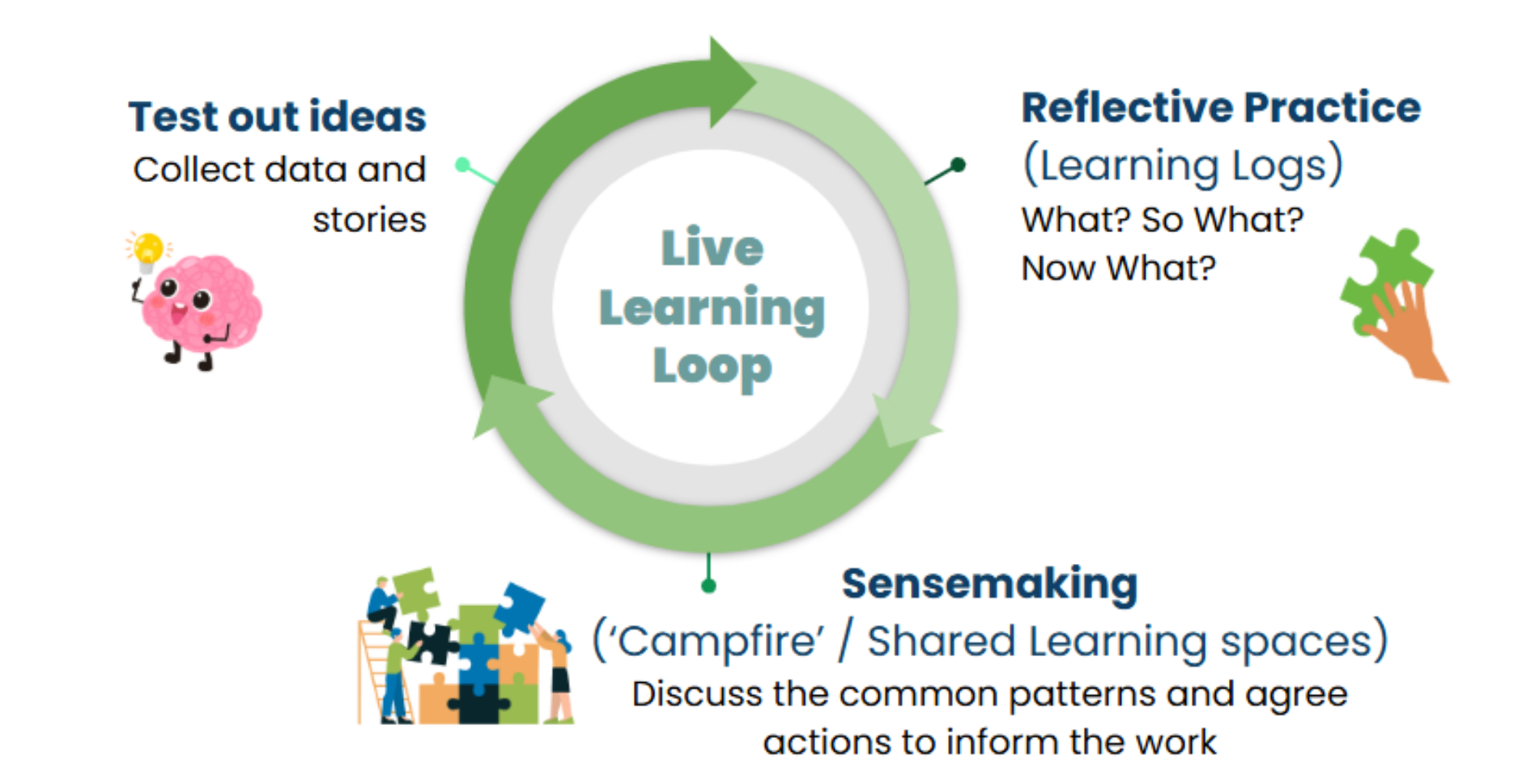
Evaluation and Learning IS the work; it’s a key principle of place-based working that enables us to navigate complex systems. Therefore our main purpose of evaluation shifts from ‘proving’ to ‘improving’; we need to embrace and value lots of different perspectives in order to understand the problem.
To facilitate this approach, MSP and partner organisations participate in the ‘live learning loop’:
Upskilling NELP Evaluation & Learning Ambassadors
To ensure evaluation truly becomes “everyone’s business” across the Liverpool City Region, we launched the LCR Evaluation & Learning Ambassador Programme in partnership with NELP and Sport England.
Moving away from traditional evaluation that simply asks “did it work?”, this programme trains local partners to embrace complexity and ask richer, place-based questions: “what works, for whom, in what contexts, and why?”.
By upskilling a distributed network of Ambassadors in Theories of Change, system maturity, and data sensemaking, we are empowering confident system-thinkers to lead our live learning loops and turn community reflections into real-world action.
Read more about our first cohort of Evaluation & Learning Ambassadors and watch the video.
The opportunity to develop a LCR Evaluation & Learning (E&L) Consortia came about by having conversations with Places about what their shared evaluation and learning capacity could look like. Through their respective Development Awards, Liverpool, Sefton and St Helens identified a desire to want to work together to share capacity and learning, with Places supported in the evaluation and learning space by MSP through a shared commitment outlined in the LCR Development Award.
Using knowledge and connections of local and national evaluation partners and academic organisations with a strong track record of place-based/whole-systems working and physical activity/policy, MSP set some solid foundations by bringing together an initial group of organisations to explore what working together could look like, supplemented by suggestions from Places and other partners. We brought Places and evaluation partners together to discuss what each party could bring to the table and how they could work together, resulting in an exercise for partners to discuss collaborative working with each other and articulating via short proformas so that Places could determine what would be a good mix of partners to help test a Consortia model.
An initial vision was co-produced by evaluation partners, Places and MSP that articulated the outcomes we wanted to achieve together, including:
Web Design by Twentytwo