

The latest figures from Sport England’s Adult Active Lives Survey (covering November 2024 to November 2025) have been released, giving us an insight into physical activity levels in Liverpool City Region and across the country.
What is the data telling us? What does it mean for our region? And what do we do about it now?
From its world-renowned sporting heritage to the devolution footprint that makes real regional change possible, there is a lot to be proud of in Liverpool City Region.
The work of our movement for movement is to ensure that the top level is connected to realities on the ground, to make active lives accessible to all.
Looking at the data across Liverpool City Region, here is a snapshot of how current activity and inactivity levels compare over the years since the 2015-16 baseline:
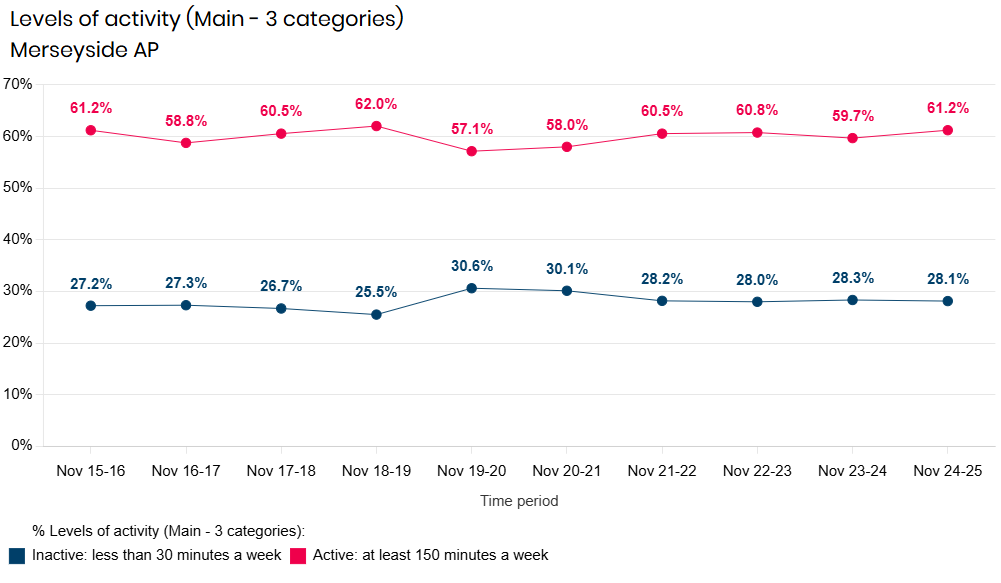
While it can be tempting to zoom in on year-on-year fluctuations, it’s best to take short-term shifts with a pinch of salt.
The Active Lives Survey offers just one perspective – a snapshot based on a relatively low sample size – so we always encourage looking to the longer-term trajectories for context, rather than reacting to single-year jumps or dips.
Locally, Liverpool City Region reflects a story of long-term stability. Despite challenges and inequalities, our region’s levels of physical activity and inactivity have remained largely resilient compared to baseline levels in 2015-16.
When we pull the lens back, the overarching national story is positive too. Adults in England are now more active than at any point in the last decade, with a record 64.6% of the population meeting the Chief Medical Officers’ guidelines. The strong post-pandemic recovery is continuing to hold.
While the stable top-level figures are encouraging, we know that these broad averages often mask persistent inequalities.
The data serves as a reminder that the opportunity to be active is still not shared equally:
How do we use this data to move forward?
These findings reinforce exactly why collective, place-based approaches are so vital.
We can’t rely on quick fixes to make real and lasting change to underserved communities. Instead, it’s about the long, complex work of shifting deeply ingrained inequalities to enable people to live healthier, more active lives.
We want to get to a point where:
This survey provides a helpful temperature check, but it is just one piece of the puzzle. We look forward to continuing our work alongside our Place Partners, using insights like this to ask the right questions, understand our communities better, and collectively shape an environment where everyone in the Liverpool City Region has the opportunity to live an active life.
Partners in each of the six boroughs of Liverpool City Region will be hosting Data Roadshows in autumn to explore what this data means at a local level. To find out more or register your interest in attending, please email admin@merseysidesport.com.
Web Design by Twentytwo